
Southern Horizons ~
A Moroccan Odyssey
September 9 ~ 21, 2027
$4,700 per person
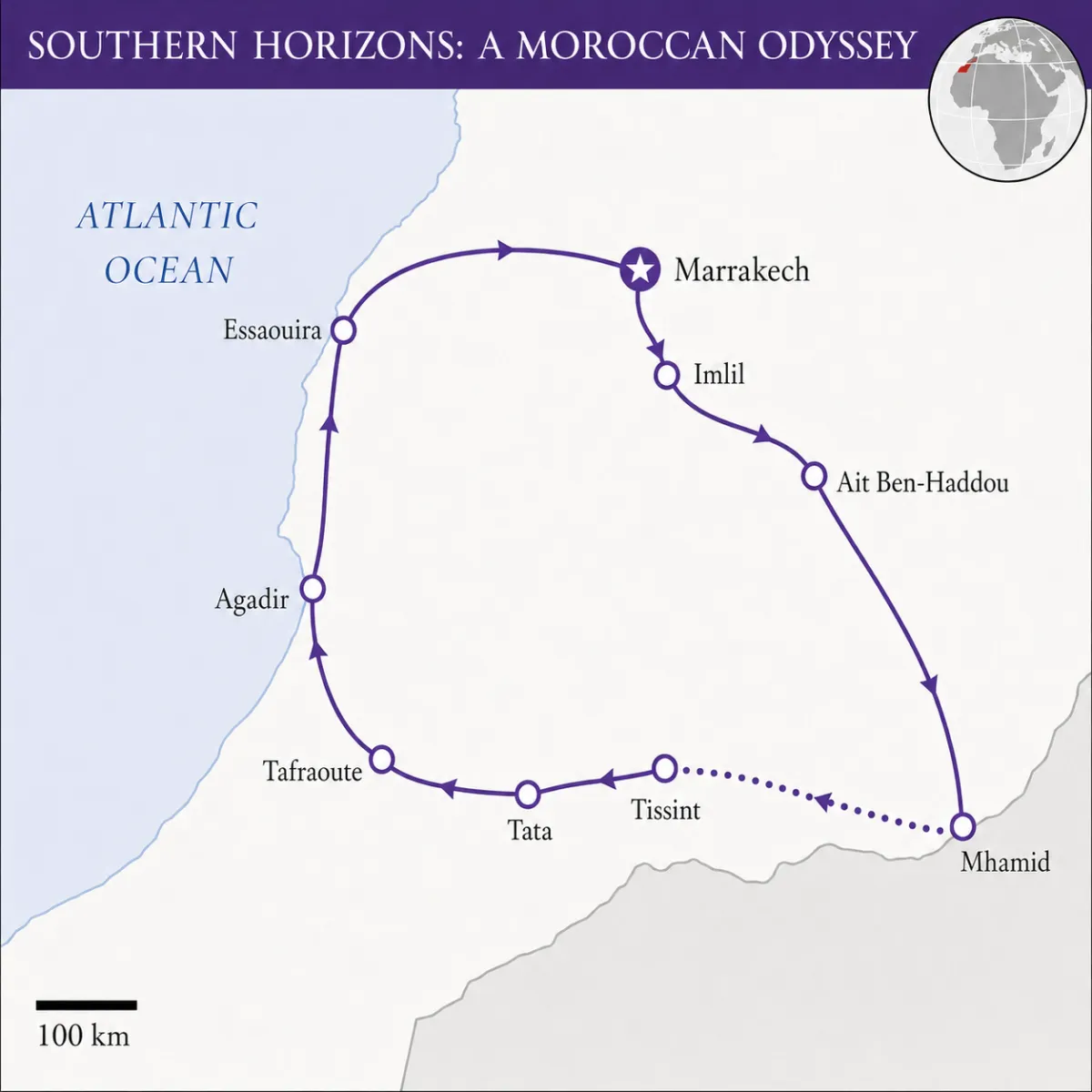
Day 1: Arrivals in Marrakech
Welcome to Morocco ~ and to the beginning of a journey into its remarkable south, where mountain villages, earthen kasbahs, desert silence, palm-filled valleys, and Atlantic breezes unfold one after another like chapters in an old story.
After arriving in Marrakech, you'll settle in to rest from your travels. Depending on arrival times, those who wish may step out for a gentle first walk through the medina, letting the colors, sounds, and scent of spice offer the first whisper of what is to come.
This evening, we will gather for a welcome meeting in the hotel, followed by our first dinner together, sharing the table as the journey begins to gather shape around us.
Day 2: Imlil & Aroumd
This morning, we leave the city behind and make our way into the High Atlas Mountains, where the air turns cooler, the roads begin to climb, and Morocco reveals a quieter, more grounded kind of beauty.
After arriving in the mountain village of Imlil, we'll continue on foot for about an hour to nearby Aroumd (known locally as Armed), a peaceful Amazigh village tucked into the surrounding slopes. The walk is moderate but beautiful ~ a chance to slow down, notice the terraced hillsides, and feel the landscape beginning to pull us away from ordinary life.
This afternoon, we'll take a guided mountain walk through the surrounding scenery. Expect sweeping views, stone paths, cultivated terraces, and the soft, steady rhythm of village life.
Tonight, we will share rooms in our mountain guesthouse; rest will come easily in the clean, quiet mountain air. Lunch and dinner are included, and we will only take a small overnight bag for tonight; our larger luggage will be securely held while we enjoy the simplicity of rural mountain life tonight.
Day 3: Ait Ben-Haddou
Today's journey carries us across one of Morocco's most dramatic mountain routes, winding through the High Atlas and pausing at scenic viewpoints along the Tizi n'Tichka Pass.
By late afternoon, we arrive at the legendary Ksar of Ait Ben-Haddou, a UNESCO World Heritage Site and one of the most iconic visions of southern Morocco. Its clay towers and narrow passageways have appeared in countless films and television series, but standing before it in person feels entirely different ~ older, warmer, more alive.
As golden hour settles over the landscape, we'll walk through the ksar with a guide while the sun turns its earthen walls to amber and copper. It is the kind of place that makes time feel layered.
Day 4: Erg Chigaga ~ Into the Sahara
Today, we descend deeper into Morocco's south, following the road toward the edge of the Sahara.
Along the way, we'll stop in the desert village of Tamegroute, known for its ancient library and its distinctive green-glazed pottery traditions. It is a place where scholarship, faith, craft, and earth have quietly coexisted for centuries.
Then the pavement ends, and the adventure changes shape.
An exhilarating 4x4 journey takes us off-road and into the wild open expanse of Erg Chigaga, one of Morocco's most remote and majestic dune regions. From there, we continue by camel, moving slowly across the sand as the sun begins to sink toward the horizon.
Tonight, we dine in the desert (included) and gather beneath a sky full of stars, with traditional music rising into the night air after dinner.
Day 5: Erg Chigaga ~ Desert Day
Today is not about getting somewhere. It is about being nowhere.
The Sahara invites a different pace ~ one made of vast horizons, wind-sculpted sand, and stretches of quiet that feel almost impossible to find anywhere else. Those who wish may join a guided desert walk with a picnic lunch and the deeply meaningful chance to share tea with a nomad family. Others may choose to rest, read, journal, wander barefoot over the dunes, or simply sit still long enough to feel the desert settle around them.
As evening arrives, we return once more to the soft gold of sunset and the incomparable hush of the Sahara after dark. Today's meals are included with our accommodation.
Day 6: Tissint & Tata
After breakfast, we leave the dunes behind and begin our journey toward Tata, an oasis town tucked into Morocco's far south.
Along the way, we'll stop at the Tissint Waterfalls, an unexpected ribbon of water and rock in a region more often defined by heat, dust, and desert tones. The contrast feels almost secret, as though the landscape has been keeping a surprise for those willing to travel this far.
By evening, we arrive in Tata, with time to rest and let the day's shifting scenery sink in.
Day 7: Tafraoute
Today, the south becomes stranger, older, and even more visually astonishing.
Our journey toward Tafraoute includes a stop at Agadir Aït Kine, a beautifully restored collective granary in a traditional village surrounded by watchtowers ~ a remarkable glimpse into the ingenuity and communal life of Morocco's Amazigh south.
Later, we'll visit the famous Painted Rocks near Tafraoute, where enormous granite boulders were transformed into a surreal outdoor artwork across the already otherworldly Anti-Atlas landscape. Whether you find them playful, peculiar, or unexpectedly moving, they are impossible to forget.
By afternoon, we arrive in Tafraoute, nestled among rounded pink granite mountains that glow softly as the light changes.
Day 8: Tafraoute & the Ameln Valley
This morning, we step deeper into the quiet beauty of the Anti-Atlas during a guided hike through the Ameln Valley.
This region feels both open and intimate ~ palm groves, traditional homes, rocky hillsides, and mountains rising in warm shades of rose and gold. As we walk, we'll experience a Morocco far from the usual tourist trail, one that reveals itself gently to those who come with curiosity.
We'll also visit a traditional home and share lunch with a local family, a moment of welcome and connection that brings the landscape to life through the people who call it home.
Day 9: Agadir
Today, we leave the mountains behind and travel west toward the Atlantic coast.
By afternoon, we arrive in Agadir, where the sea air offers a soft shift in energy after days of desert roads, valleys, and mountain paths. The rest of the day is yours to enjoy as you wish ~ rest, walk along the waterfront, or settle into the slower rhythm of a coastal evening.
Those who wish may join for sunset from Agadir Oufella, the historic hilltop kasbah overlooking the city and the ocean beyond.
Day 10: Taghazout & Essaouira
Our journey continues north along the Atlantic coast, with ocean views, wind-shaped landscapes, and the easy pleasure of moving through Morocco beside the sea.
Along the way, we'll stop at a supermarket to gather our own picnic provisions, then pause in the laid-back surf village of Taghazout for a brief wander, and perhaps a coffee.
From there, we'll continue north to enjoy our picnic lunch along the coast before making our way toward Essaouira, with stops to visit an argan cooperative and learn more about one of southern Morocco's most important traditions.
By afternoon, we arrive in Essaouira ~ a fortified port city of white walls, blue doors, sea gulls, and salt air. The evening is yours, with the option to gather for dinner overlooking the Atlantic as waves break against the old stone ramparts.
Day 11: Essaouira
Today, we explore Essaouira's enchanting medina with a local guide. A UNESCO World Heritage Site, this 18th-century fortified town carries the soul of an old trading port: windswept, artistic, and unlike anywhere else in Morocco.
For lunch, we'll choose our own fresh seafood at the fish market and have it prepared for us, dining in the lively, local style that makes this meal feel like an experience rather than simply a stop to eat.
The afternoon is yours to enjoy Essaouira as you wish: shop in the medina, stroll along the beach, settle into a café, or join for a traditional hammam and massage. This city is best met without hurry.
Day 12: Marrakech
This morning, we return to Marrakech, where the final chapter of our journey begins.
In the afternoon, we'll step into the ancient medina and its legendary souks before making our way to Jemaa el-Fnaa, the great square at the heart of the city. By day, it stirs with orange juice sellers, storytellers, and snake charmers; by night, it becomes something entirely different ~ smoke curling from food stalls, music rising through the crowd, and the Red City pulsing around us.
This evening, we celebrate our journey together with a farewell dinner in Jemaa el-Fnaa Square, surrounded by the energy of Marrakech and the accumulated wonder of all we have crossed to arrive here.
Day 13: Departures from Marrakech
Today, we say goodbye.
Airport transfers will be arranged according to your departure schedule.
We hope you leave carrying the south with you: the hush of desert stars, the glow of kasbah walls at sunset, mountain paths and family tables, ocean wind, strange painted stones, and the quiet truth that Morocco is never just a place you visit ~ it follows you home, having transformed you forever.

Included:
Private Accommodations
Licensed English-Speaking Guide
Licensed Local Guides
Transportation
Bottled Water
Breakfast Daily, Select Lunches & Dinners
Not Included:
Airfare & Airport Transport
Travel Insurance (Required)
Most Lunches & Dinners
Snacks, Drinks, & Souvenirs
Laundry Service
Tips
Bringing your travel partner? Share a room and book together for a reduced rate ~ some journeys are even better shared.
Frequently Asked Questions
How long does it take to fly to Morocco from the US?
Depending on your number of stops and length of layovers, expect 18 to 24 hours total. When booking, look for shorter or fewer layovers to stay within that window, and avoid layovers under 90 minutes.
Do I need to be a hiker or an athlete to participate in this trip?
You don't need to be a hiker or an athlete, but you do need an honest sense of your own fitness level.
Many of our trips include walking and hiking over steep, uneven, rocky, sandy, or slippery terrain. Some of it can feel moderate to strenuous if you're not used to regular exercise or an active lifestyle. We move with care, take breaks, and never treat the journey like a race ~ but Morocco itself isn't always gentle underfoot.
You should be comfortable with stairs, hills, and extended walking. Elevators are uncommon, and many of the most beautiful places we visit ask a little effort of you to reach them. Each itinerary includes more specific guidance on its physical demands, so you can choose the trip that's right for you.
I'm an over-packer. How many suitcases can I bring?
Good news: your trip with Take A Better Trip includes our guide to packing light for adventure travel like this. We strongly recommend carry-on only ~ one small roller bag and one personal-size backpack or tote.
Two reasons why: lost luggage can derail a trip in more ways than one, and we're on the move almost every day, so dragging large suitcases in and out of new hotels each night gets old fast. We'll show you exactly how to pack just what you need.
If I have to pack light, can I still do laundry?
Yes. Laundry service is available anywhere we spend two consecutive nights, and it's typically affordable with a one-day turnaround.
Can I share a room with my partner or travel companion?
Yes ~ for the duration of the entire journey, we offer a discounted shared room option for couples and friends traveling together. Complete the booking process with both guests in the same booking to receive the reduced rate.
What is a "shared room"?
Occasionally our trips will take us to special places that are not normal hotels ~ Sahara Desert tents, mountain gites, family owned guest houses, etc. Often we must share rooms with other guests due to limited space in these accommodations. This is usually only one or two nights per trip, and it tends to become one of the most fun experiences of the entire journey. Only guests of the same sex will ever be roomed together, and everyone always has their own bed.
Can I drink the water in Morocco?
Travelers are generally advised against drinking tap water in Morocco, including ice, unless we've confirmed it's safe.
Bottled water is plentiful and provided throughout your trip. Bring your own refillable bottle, since we won't distribute individual-size bottles. Brushing your teeth with tap water is usually fine as long as you don't swallow it, though it's ultimately at your own discretion.
What languages are spoken in Morocco?
Darija (a Moroccan dialect of Arabic), French, several dialects of Tamazight (the original native north African language) Spanish, and some English (mostly within tourism). Depending on the region, you may hear more.
How will I get a taxi at the airport?
Before departure, you'll receive emails preparing you for landing in Morocco, including where to book a taxi, where to exchange cash, and anything else you'll want to know before we meet up. If you would prefer a private pickup from the airport, please select that option during checkout for an additional fee.
Can I arrive early and spend time on my own before the tour begins?
Yes, and we encourage it. We're happy to help arrange extra nights at your hotel ahead of the official start date. Just know that we won't be there in person until the trip begins, though we're reachable by phone.
How will I communicate using my phone?
In Morocco, you'll rely mostly on internet-based communication ~ apps like WhatsApp, social media, and email ~ rather than traditional calls or texts. Anyone hoping to reach you at home will need to use these instead.
Before departure, we'll send you a link to optionally purchase and install an eSIM, giving you mobile internet through local cell towers so you're not dependent solely on hotel or restaurant Wi-Fi. A physical SIM card is available after arrival, but it's less convenient and carries the risk of misplacing your original SIM while it's out of your phone.
All guests are asked to download WhatsApp and set up an account before the trip. We use it for group communication, and its photo-sharing makes it especially useful while traveling together.
How much cash should I bring?
You'll use cash for nearly every purchase in Morocco. We'll send trip-specific guidance before departure, but as a general rule: bring fresh, clean $100 and $20 bills, since exchange clerks often decline $5s and $1s. Exchange offices are easy to find. ATMs are plentiful too, though they can carry steep international fees if your bank isn't set up for travel first.
What is the dress code in Morocco?
Simpler than it sounds. As in most Muslim cultures, women are asked to dress a bit more modestly than is typical in the US ~ covering shoulders and thighs, and avoiding anything especially tight or revealing, particularly in rural areas. You'll see tourists in the cities wearing far less, but that doesn't mean it's appreciated. Covering your head or hair is not required.
For men, basic respect goes a long way ~ sleeved shirts, longer shorts, and nothing profane or explicit.
Should I bring my professional camera?
If you have a good system for traveling with it, bring it ~ just pack your cleaning supplies, since we'll move through areas that are dusty, sandy, windy, and sometimes salty.
Photographing local people directly is a real invasion of privacy and should only be done with permission. Identifiable photos of children are not permitted. General scene shots that happen to include people are fine.
Copyrights 2025 | Take A Better Trip™ | Terms & Conditions