
A Moroccan Holiday Dream ~
Christmas & New Year's Celebration
December 21, 2026 - January 2, 2027 ~ $3,000 per person
December 21, 2027 - January 2, 2028 ~ $5,200 per person
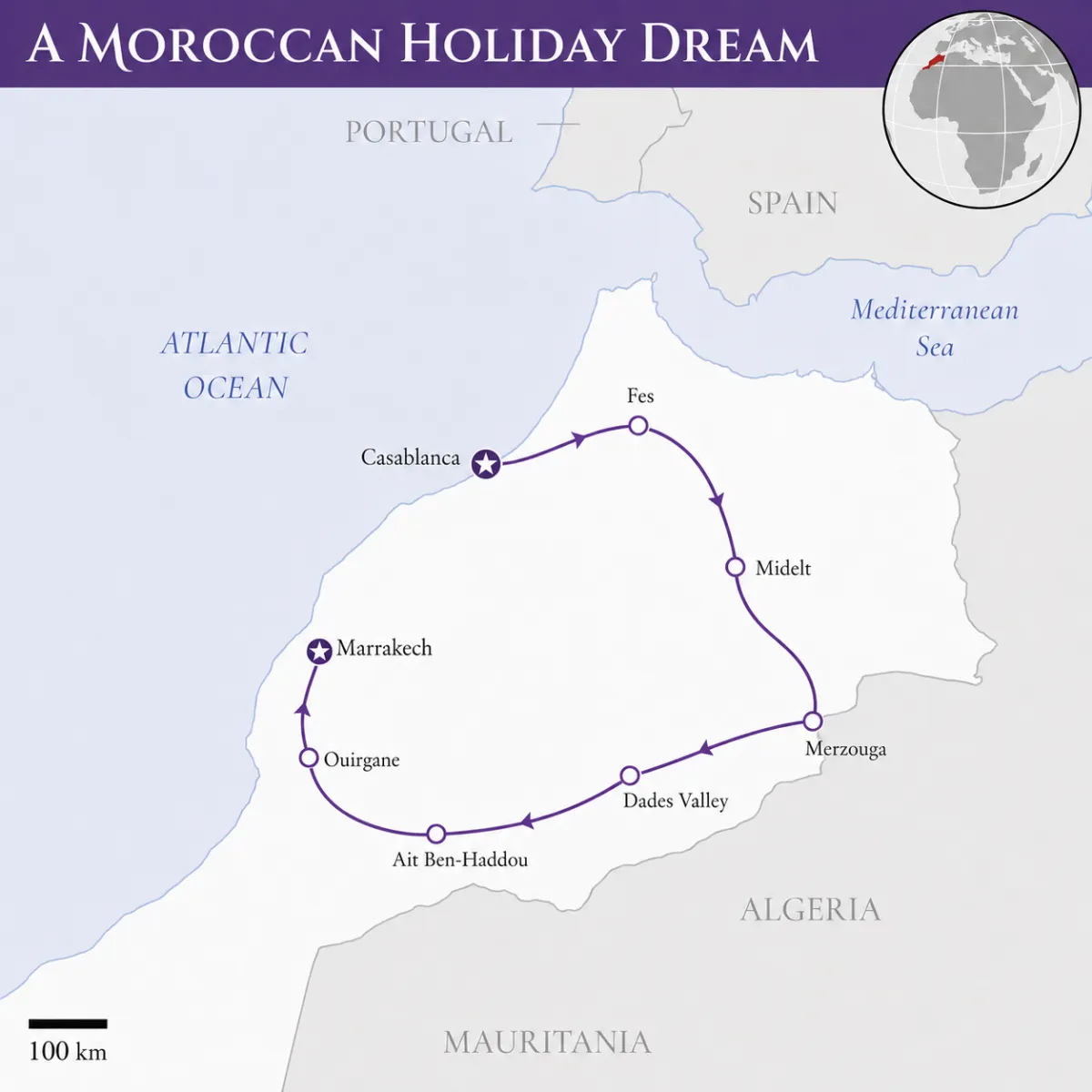
Day 1: Arrivals in Casablanca
Welcome to Morocco, and to a holiday journey unlike any other: a dreamlike crossing from Atlantic arrival to ancient medina, cedar mountains, desert silence, glowing valleys, peaceful High Atlas villages, and the electric final celebration of the year in Marrakech.
After arriving in Casablanca, settle in and rest from your travels. Depending on arrival times, those who wish may have the option to visit the Hassan II Mosque and take a short introduction to the city.
This evening, we will gather for a welcome meeting at the hotel, followed by our first dinner together, beginning the season in the company of fellow travelers and the promise of everything still ahead.
Day 2: Casablanca to Fes
This morning, we leave Casablanca behind and begin the journey inland toward Fes, one of Morocco's great imperial cities and one of the most astonishing living medinas in the world.
The road carries us away from the Atlantic and deeper into the country, offering a gentle first glimpse of Morocco beyond the coast: towns, fields, roadside life, and the slow unfurling of a landscape that will continue to change around us in the days ahead.
By afternoon or early evening, we arrive in Fes. Settle in, take a breath, and let the anticipation build. Tomorrow, the city opens its ancient doors.
Day 3: Fes
Today, we experience one of the most extraordinary cities in the world.
We'll begin from above, taking in a panoramic view of the sprawling Fes medina before descending into its maze of ancient lanes. During a full guided immersion, we'll experience the city through its living crafts and enduring traditions: the famous tanneries, the rhythmic work of the metal coppersmiths, zellij tileworkers, ceramic artisans, the exquisite Al-Attarine Madrasa, the Mellah, and the countless textures, tastes, scents, and sounds that make Fes feel impossibly, overwhelmingly alive.
Fes is dense, dazzling, and utterly absorbing ~ a city that demands your attention and rewards it with layer after layer of living history.
This evening, we have the option to share a special meal experience with a local family or enjoy dinner together, depending on the rhythm of the group.
Day 4: Fes to Midelt
Today is Christmas Eve, and Morocco begins to shift around us.
We leave the intensity of Fes and travel south through cedar country, mountain roads, open highland landscapes, and the quieter spaces between regions. This is a day of transition ~ from ancient city toward the vast southern landscapes that wait beyond the Middle Atlas.
By late afternoon or evening, we arrive in Midelt, a mountain town often used as a resting place between Fes and the desert. It may not be the place most people imagine spending Christmas Eve, but that is part of the beauty of this journey: the holiday begins to take on a different shape, one marked by movement, discovery, and the feeling of being far from the ordinary.
Tonight, we share Christmas Eve dinner together and rest before tomorrow's arrival into the Sahara.
Day 5: Christmas Day in the Sahara Desert
This Christmas morning, we wake in the mountains and travel toward one of Morocco's most extraordinary landscapes: the Sahara.
The road from Midelt to Merzouga is one of the great crossings of the journey. The scenery changes dramatically as we descend toward palm valleys, desert towns, open plains, and finally the golden dunes rising on the horizon.
By late afternoon, the Sahara appears before us ~ soft, immense, and almost unreal. After arriving at our desert camp, we'll ride camels across the dunes as the light begins to turn golden and the day becomes something none of us could have planned in any ordinary holiday season.
Tonight, we gather for a Christmas dinner in the desert, followed by traditional music and the deep quiet only the Sahara can offer. It may not look like Christmas at home, but that is precisely what makes it so remarkable: candlelight, desert stars, shared laughter, and the sense that the holiday has found us in a place larger than imagination.
Shared luxury tents tonight that include heat and toilets.
Day 6: Sahara Sunrise, Todgha Gorge & Dades Valley
If you are willing to wake early, the desert offers a magnificent gift: sunrise over the dunes, when the sand shifts through shades of rose, gold, and fire before the world fully stirs. A short walk from camp gives you the perfect viewpoint of sunrise.
After breakfast, we say goodbye to the Sahara and travel west toward the spectacular natural wonder of Todgha Gorge. We'll take time to walk through the gorge and absorb its towering scale before continuing into the Dades Valley: another inspiring natural wonder of southern Morocco.
By evening, we arrive in one of Morocco's most striking landscapes ~ a valley of red rock, winding roads, villages, and earth-toned mountains that seem to glow from within. We'll settle in here for two nights, allowing the south to slow us down and draw us in.
Day 7: Dades Valley
Today, we stay inside the beauty of the Dades Valley instead of rushing through it.
The valley surrounds us with dramatic rock formations, quiet villages, cultivated fields, and the immense calm of Morocco's southern mountains. We'll explore at a gentler pace, with a scenic drive through the gorge and valley landscapes, time to rest in the mountain setting, and, depending on the group, the option for a moderate walk or guided valley hike.
After the movement of Christmas and the desert, this day offers space to breathe. The Dades Valley is not simply a stop between places; it is a place to feel the land beneath the itinerary.
Day 8: Dades Valley to Skoura & Ait Ben-Haddou
Today, we continue west through southern Morocco, passing palm groves, a land of kasbahs, and landscapes shaped by centuries of life along the desert's edge.
If timing allows, we'll stop to explore Kasbah Amridil, one of Morocco's most beautifully preserved historic kasbahs, with time for lunch in a local setting or along the route.
From there, we continue onward to the legendary Ksar of Ait Ben-Haddou. A UNESCO World Heritage Site and one of the country's most iconic places, its clay towers and narrow passageways have appeared in countless films and series. While its long film history is fascinating, the real reward is reaching the top at golden hour, when the surrounding landscape opens wide and the earthen walls glow in the fading light.
Day 9: Ait Ben-Haddou to Ouirgane
Our journey turns toward the High Atlas today, carrying us across dramatic mountain roads and one more great sweep of Moroccan landscape.
We travel from Ait Ben-Haddou through the mountains and onward toward Ouirgane, a peaceful village area known for its red earth, green valleys, quiet trails, and softer mountain rhythm. This is a day of scenery and transition, trading the desert's edge for the calm of the High Atlas.
By late afternoon or evening, we arrive in Ouirgane and settle into a different kind of stillness. After the long roads and dramatic southern landscapes, the mountains invite us to exhale.
Day 10: Ouirgane
Today is a slower day in the High Atlas, and deliberately so.
Ouirgane offers a gentler side of mountain life: quiet paths, village landscapes, red hills, olive groves, and the kind of natural beauty that does not ask to be conquered. Depending on the group, we may take a guided walk, visit nearby villages, or simply enjoy time to rest, read, reflect, and take in the setting.
This is the pause before Marrakech and the turning of the year: a day to let the journey settle into you before the celebration begins.
Day 11: Ouirgane to Marrakech ~ New Year's Eve
This morning, we leave the calm of Ouirgane and make our way to Marrakech, where the final chapter of the journey begins.
By afternoon, we arrive in the Red City. If time allows, we'll step into the ancient medina and its legendary souks before making our way toward Jemaa el-Fnaa Square. By day, the square hums with juice sellers, storytellers, and movement; by evening, smoke rises from food stalls, music gathers in the air, and Marrakech becomes something entirely different ~ vibrant, chaotic, fascinating, and alive.
Tonight, we celebrate New Year's Eve together in Marrakech, closing one year and welcoming the next inside one of Morocco's most unforgettable cities.
Day 12: Marrakech ~ New Year's Day
Today begins slowly, as all good New Year's Days should.
After a night of celebration, we allow the morning to unfold at an easier pace. Depending on the rhythm of the group, the day may include guided Marrakech experiences, time in the souks, a visit to gardens or historic sites, or simply the freedom to enjoy the city in your own way.
This evening, we gather for a farewell dinner together ~ a final shared table after ancient medinas, cedar mountains, Christmas in the Sahara, red valleys, quiet High Atlas days, and a New Year's Eve we will remember for years to come.
Day 13: Departures from Marrakech
Today, we say goodbye.
Airport transfers will be arranged according to your departure schedule. We hope you leave Morocco carrying something deeper than photographs: the astonishment of Fes, Christmas under desert stars, the quiet beauty of the Dades Valley, the peace of Ouirgane, and the feeling of beginning a new year inside a story far larger than your own.

Included:
Private Accommodations
Licensed English-Speaking Guide
Licensed Local Guides
Transportation
Bottled Water
Breakfast Daily, Select Lunches & Dinners
Not Included:
Airfare & Airport Transport
Travel Insurance (Required)
Most Lunches & Dinners
Snacks, Drinks, & Souvenirs
Laundry Service
Tips
Bringing your travel partner? Share a room and book together for a reduced rate ~ some journeys are even better shared.
Frequently Asked Questions
How long does it take to fly to Morocco from the US?
Depending on your number of stops and length of layovers, expect 18 to 24 hours total. When booking, look for shorter or fewer layovers to stay within that window, and avoid layovers under 90 minutes.
Do I need to be a hiker or an athlete to participate in this trip?
You don't need to be a hiker or an athlete, but you do need an honest sense of your own fitness level.
Many of our trips include walking and hiking over steep, uneven, rocky, sandy, or slippery terrain. Some of it can feel moderate to strenuous if you're not used to regular exercise or an active lifestyle. We move with care, take breaks, and never treat the journey like a race ~ but Morocco itself isn't always gentle underfoot.
You should be comfortable with stairs, hills, and extended walking. Elevators are uncommon, and many of the most beautiful places we visit ask a little effort of you to reach them. Each itinerary includes more specific guidance on its physical demands, so you can choose the trip that's right for you.
I'm an over-packer. How many suitcases can I bring?
Good news: your trip with Take A Better Trip includes our guide to packing light for adventure travel like this. We strongly recommend carry-on only ~ one small roller bag and one personal-size backpack or tote.
Two reasons why: lost luggage can derail a trip in more ways than one, and we're on the move almost every day, so dragging large suitcases in and out of new hotels each night gets old fast. We'll show you exactly how to pack just what you need.
If I have to pack light, can I still do laundry?
Yes. Laundry service is available anywhere we spend two consecutive nights, and it's typically affordable with a one-day turnaround.
Can I share a room with my partner or travel companion?
Yes ~ for the duration of the entire journey, we offer a discounted shared room option for couples and friends traveling together. Complete the booking process with both guests in the same booking to receive the reduced rate.
What is a "shared room"?
Occasionally our trips will take us to special places that are not normal hotels ~ Sahara Desert tents, mountain gites, family owned guest houses, etc. Often we must share rooms with other guests due to limited space in these accommodations. This is usually only one or two nights per trip, and it tends to become one of the most fun experiences of the entire journey. Only guests of the same sex will ever be roomed together, and everyone always has their own bed.
Can I drink the water in Morocco?
Travelers are generally advised against drinking tap water in Morocco, including ice, unless we've confirmed it's safe.
Bottled water is plentiful and provided throughout your trip. Bring your own refillable bottle, since we won't distribute individual-size bottles. Brushing your teeth with tap water is usually fine as long as you don't swallow it, though it's ultimately at your own discretion.
What languages are spoken in Morocco?
Darija (a Moroccan dialect of Arabic), French, several dialects of Tamazight (the original native north African language) Spanish, and some English (mostly within tourism). Depending on the region, you may hear more.
How will I get a taxi at the airport?
Before departure, you'll receive emails preparing you for landing in Morocco, including where to book a taxi, where to exchange cash, and anything else you'll want to know before we meet up. If you would prefer a private pickup from the airport, please select that option during checkout for an additional fee.
Can I arrive early and spend time on my own before the tour begins?
Yes, and we encourage it. We're happy to help arrange extra nights at your hotel ahead of the official start date. Just know that we won't be there in person until the trip begins, though we're reachable by phone.
How will I communicate using my phone?
In Morocco, you'll rely mostly on internet-based communication ~ apps like WhatsApp, social media, and email ~ rather than traditional calls or texts. Anyone hoping to reach you at home will need to use these instead.
Before departure, we'll send you a link to optionally purchase and install an eSIM, giving you mobile internet through local cell towers so you're not dependent solely on hotel or restaurant Wi-Fi. A physical SIM card is available after arrival, but it's less convenient and carries the risk of misplacing your original SIM while it's out of your phone.
All guests are asked to download WhatsApp and set up an account before the trip. We use it for group communication, and its photo-sharing makes it especially useful while traveling together.
How much cash should I bring?
You'll use cash for nearly every purchase in Morocco. We'll send trip-specific guidance before departure, but as a general rule: bring fresh, clean $100 and $20 bills, since exchange clerks often decline $5s and $1s. Exchange offices are easy to find. ATMs are plentiful too, though they can carry steep international fees if your bank isn't set up for travel first.
What is the dress code in Morocco?
Simpler than it sounds. As in most Muslim cultures, women are asked to dress a bit more modestly than is typical in the US ~ covering shoulders and thighs, and avoiding anything especially tight or revealing, particularly in rural areas. You'll see tourists in the cities wearing far less, but that doesn't mean it's appreciated. Covering your head or hair is not required.
For men, basic respect goes a long way ~ sleeved shirts, longer shorts, and nothing profane or explicit.
Should I bring my professional camera?
If you have a good system for traveling with it, bring it ~ just pack your cleaning supplies, since we'll move through areas that are dusty, sandy, windy, and sometimes salty.
Photographing local people directly is a real invasion of privacy and should only be done with permission. Identifiable photos of children are not permitted. General scene shots that happen to include people are fine.
Copyrights 2025 | Take A Better Trip™ | Terms & Conditions